Historic steps for AI and Liberal Arts, led by Richmond
AI approach sets the standard for liberal arts education
In the rapidly evolving landscape of artificial intelligence, liberal arts institutions are facing the dual challenge of keeping pace with technological advancements while also maintaining the values that define the liberal arts experience.
The University of Richmond is leaning into the challenge on multiple fronts.
“It’s natural to feel both wary and excited when thinking about emerging technologies,” said Kevin Hallock, Richmond’s president. “They present opportunities and have limitations. They come with both costs and benefits. But universities operate at the frontiers of knowledge.”
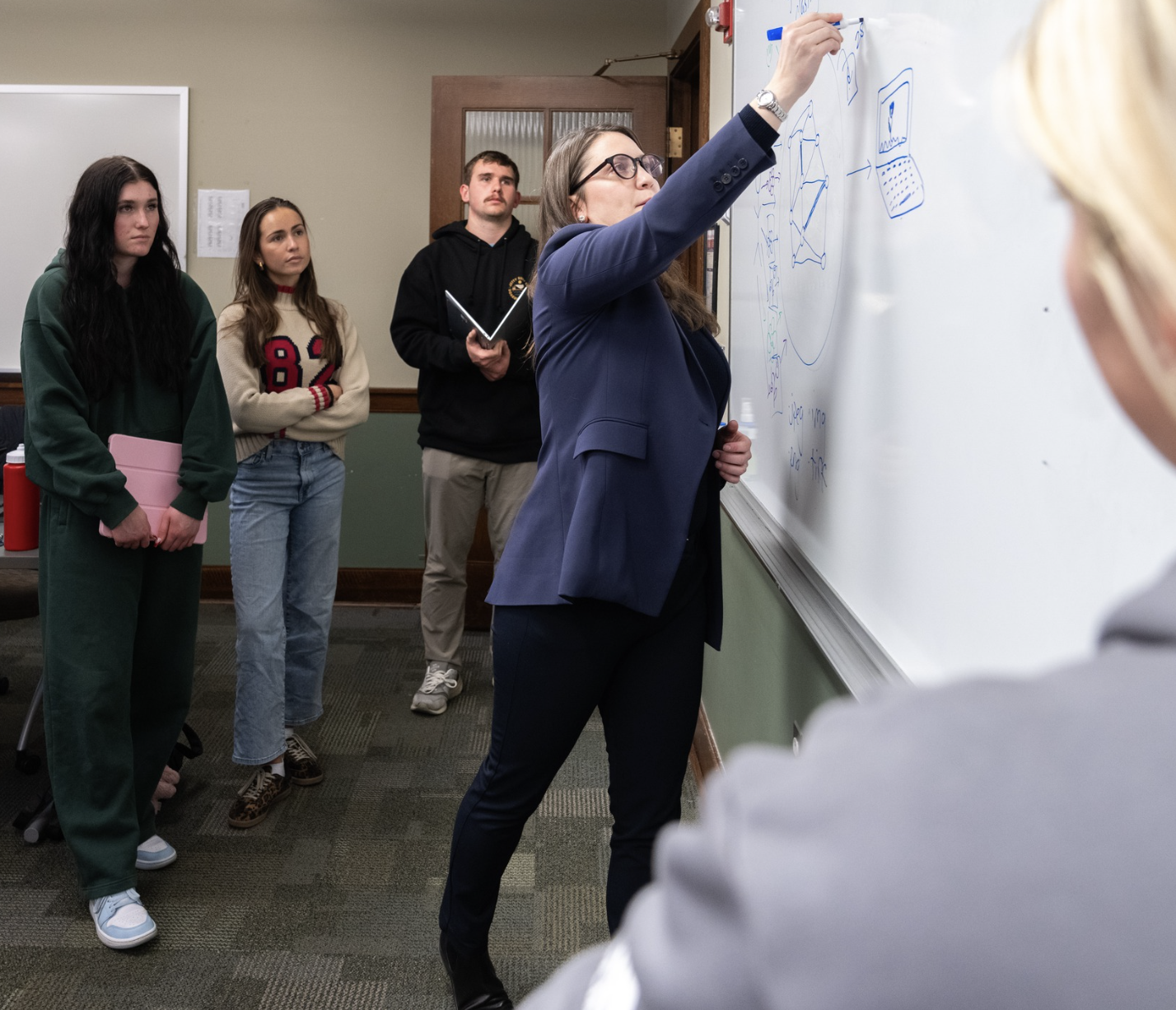

Center for Liberal Arts and AI
Initiated and led by Richmond, the Center for Liberal Arts and AI (CLAAI) brings together researchers, students, and educators from 15 liberal arts universities that make up the Associated Colleges of the South. Their goal is to help shape how the liberal arts education can and should evolve in the AI era. As part of its work, CLAAI will explore the pressing social, cultural, and legal dimensions of artificial intelligence.
This is the inaugural year for CLAAI. There are 23 faculty fellows in the cohort and eight are from Richmond. Lauren Tilton, a digital humanities professor, is CLAAI’s director. She says CLAAI will provide support for research and curriculum offerings, offer in-person and digital workshops to help expand AI methods, and help CLAAI fellows navigate ethical, legal and social issues.
“We are exploring how interdisciplinary methods can make AI more accessible, culturally informed, and responsible.” said Tilton.
Campus-wide focus on AI
The University of Richmond community is working collaboratively to understand how AI can support and advance its mission. University leadership has invited insights and feedback from students, staff, faculty, alumni, parents, and external experts to help chart a responsible path forward.
Recently, Richmond launched a Presidential Advisory Group on AI with the goal of creating campus-wide recommendations that include academic integration of AI, enhancements to day-to-day operations leveraging the technology, and a set of policies and governance structures for safeguarding university data and intellectual property. The University also is focused on maintaining the integrity and human-centeredness that is at the heart of a Richmond education.
“Our communities make discoveries that expand human understanding, and we educate the next generation who will shape our future.”

AI in Teaching
AI in the curriculum is expansive at Richmond. Courses in all five academic schools are engaging on a variety of AI topics, from first-year seminars to graduate courses in business and law.
Faculty are using generative AI in a variety of ways. Some incorporate it into their syllabi, allowing students to use the technology to run data analytics, risk assessment, image generation, or fact finding to name a few. Others use it as an example of how AI is still evolving and its results can be flawed.
Technology consultants in the Weinstein Learning Center, an academic support hub on campus that offers tutoring, academic coaching, and writing help, are offering personalized training to help students practice with AI and develop AI literacy.
Meanwhile, the Faculty Hub, which acts as an informational, technical, pedagogical, and ethical support center for professors, is helping faculty thoughtfully integrate and leverage AI. Faculty members may participate in one-on-one counseling, workshops, and training in the Faculty Hub to not only identify best practices for AI, but receive advice on how to use the technology to enhance or organize their course offerings as well as address any challenges or concerns.
“There’s a lot to think about,” says Hallock. “We must continue to ask, ‘What role could these technologies play at Richmond?’ and ‘What else might our students need to learn to succeed and flourish?’”
Spider AI
To support Generative AI for faculty and students, the University of Richmond has created its own large language model (LLM) similar to Chat GPT, Gemini, or Claude. Called Spider AI, it aggregates GenAI tools from OpenAI, Anthropic, and Google, providing access to students and faculty at no cost to them.
Spider AI emerged from a faculty learning community exploring AI applications in teaching and has evolved into a robust system used campuswide. Spider AI provides features like chat, image generation, text-to-speech, speech-to-text, and custom assistants.